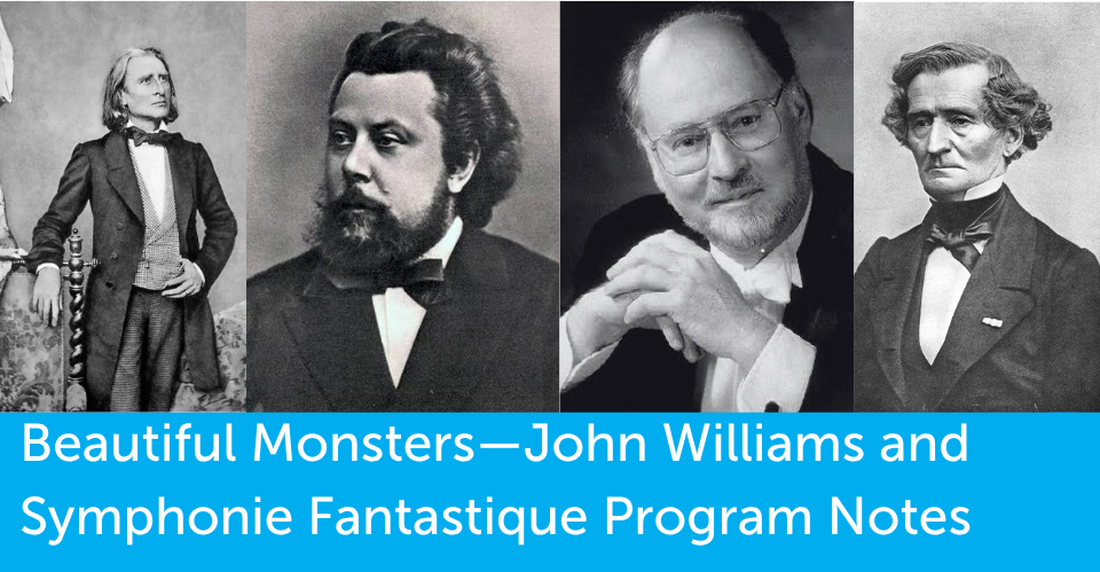
Halloween derives its name and ghostly spirit from the following day in the Medieval liturgical calendar, November 1st: All Saints’ (or Hallows’) Day. The night before, October 31st, is therefore All Hallows’ Eve — Halloween. However, more than 10,000 saints have been canonized by the Catholic Church, so an individual “name day” in the annual church calendar can only be granted to a handful of them, with all the others collectively honored on All Saints’ Day. An old tale holds that the numinous spirits of these “minor saints,” unhappy with their eternal slight, return each Hallows’ Eve to bedevil mankind in recompense. This annual parting of the veil between the worlds of the living and the dead appealed strongly to the sensibility of the 19th-century Romantics and inspired three of the works on this concert: A Night on Bald Mountain by Modeste Mussorgsky, Totentanz (“Dance of Death”) by Franz Liszt and Symphonie Fantastique by Hector Berlioz. The program opens with “Devil’s Dance” from The Witches of Eastwick, a piece of more recent origin by a composer equally adept at conjuring other worlds with his music: John Williams.
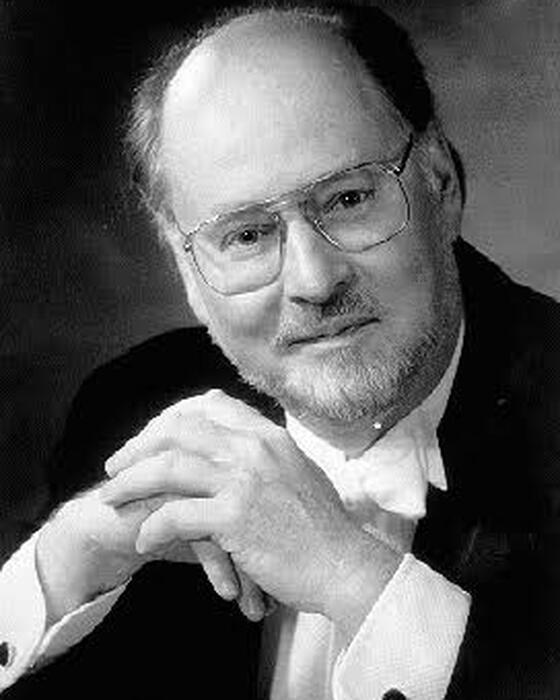
John Williams
Born February 8, 1932 in Flushing, New York.
“DEVIL’S DANCE” FROM THE WITCHES OF EASTWICK
- The Witches of Eastwick was released on June 12, 1987.
- These concerts mark the first performances of this piece by the Des Moines Symphony for a Masterworks program.
(Duration: ca. 6 minutes)
Director George Miller’s darkly comedic 1987 screen adaptation of The Witches of Eastwick, based on John Updike’s 1984 novel, starred Cher, Susan Sarandon and Michelle Pfeiffer as three dissatisfied women living in picturesque Eastwick, Rhode Island. Each has recently lost her husband (death, divorce, desertion) and they gather weekly to muse about their ideal man, who suddenly seems to turn up in Eastwick in the person of a self-professed “horny little devil” named Daryl Van Horne (played by Jack Nicholson). Daryl buys a local mansion built on the reputed site of witch burnings early in the town’s history and proceeds to seduce the three ladies using his diabolical wiles, during which they discover that they themselves are witches who have formed a coven with their regular meetings. After several unsettling paranormal events, they try to banish Daryl by creating and torturing a voodoo doll and succeed when they throw the magical likeness into a fire. Eighteen months later, the women are living together in Daryl’s mansion, each with a new baby son. The boys are playing together when Daryl appears on a TV screen and asks them to “give Daddy a kiss.” The girls advance together and shut off the TV and Daryl. John Williams’ Oscar-nominated score captures the weird world of Daryl and his witches, and he wove several sequences from the soundtrack into a concert piece titled Devil’s Dance, whose demonic style and haunted mood are reminiscent of the “Witches’ Sabbath” finale of Berlioz’s Symphonie Fantastique.
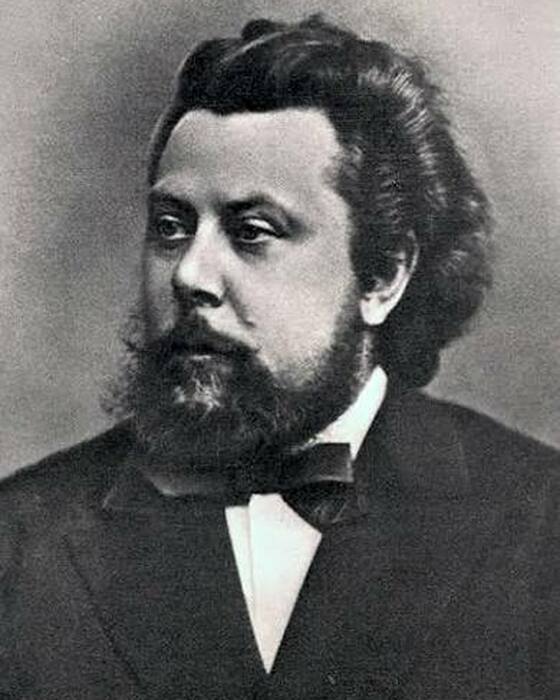
MODEST MUSSORGSKY
Born March 21, 1839 in Karevo, Russia;
Died March 16, 1881 in St. Petersburg.
A NIGHT ON BALD MOUNTAIN
Arranged by Nikolai Rimsky-Korsakov
- First performed on October 15, 1886 in St. Petersburg, conducted by Nikolai Rimsky-Korsakov.
- First performed by the Des Moines Symphony on May 3, 1953 with Frank Noyes conducting. Four subsequent performances have occurred, most recently on October 12 & 13, 2019 with Joseph Giunta conducting.
(Duration: ca. 12 minutes)
In the 1860s, Russian music was just beginning to find its distinctive voice. A number of composers — Balakirev, Cui, Borodin, Rimsky-Korsakov and Mussorgsky — explored native musical and folkloric sources as the basis of a national art and became loosely confederated into a group known as “The Mighty Handful” in Russia and “The Five” in the West. Since their works took their inspiration mainly from indigenous legends and folk music, Mussorgsky considered himself lucky to receive a commission in 1861 (when he was just 21) for a dramatic musical composition based on a specifically Russian subject. On January 7th, he wrote to his mentor, Balakirev, “I have received an extremely interesting commission [for music for a drama titled The Witch by his friend Baron Georgy Fyodorovitch Mengden], which I must prepare for next summer. It is this: a whole act to take place on Bald Mountain … a Witches’ Sabbath, separate episodes of sorcerers, a solemn march for all this nastiness, a finale — the glorification of the Sabbath into which is introduced the commander of the whole festival on Bald Mountain. The libretto is very good. I already have some material for it; it may turn out to be a very good thing.”
The mountain to which Mussorgsky referred, well known in Russian legend, is Mount Triglav, near Kiev, reputed to be the site of the annual witches’ sabbath that occurs on St. John’s Night, June 23-24, the eve of the feast of St. John the Baptist. The sinister god Chernobog, the devil himself in disguise, presides over the demonic revelries. The dramatic version of the music came to nothing, but Mussorgsky did complete a symphonic piece titled St. John’s Night on Bald Mountain in a creative frenzy in 1867. He tinkered with the music for a while and even mined some of its themes for inclusion in two later works: as a chorus for an aborted operatic project titled Mlada, a composite work to which Cui, Borodin and Rimsky-Korsakov also contributed some material; and as a choral introduction to the opera The Fair at Sorochinsk. However, A Night on Bald Mountain, Mussorgsky’s only extended orchestral work, never came to performance during his lifetime — the original orchestral version of 1867 was not published until 1968, and first recorded only in 1981.
What is now commonly known as A Night on Bald Mountain is as much the work of Nikolai Rimsky-Korsakov as of Mussorgsky. Rimsky was a self-appointed editor for many compositions by his Russian compatriots that he felt could use some polishing before being launched into the world. He thoroughly revised works by Borodin and Dargomyzsky and prepared almost all of Mussorgsky’s compositions for publication and performance. In the case of A Night on Bald Mountain, he not only smoothed out the harmonies and augmented the orchestration but also strengthened the work’s formal structure.
Rimsky prefaced his score with the following synopsis of the action portrayed by the music: “Subterranean sounds of supernatural voices ... Appearance of the spirits of darkness, followed by that of Satan himself ... Glorification of Satan and celebration of the Black Mass ... The Sabbath Revels ... At the height of the orgies the bell of the village church, sounding in the distance, disperses the spirits of darkness ... Daybreak.”
The mood of the music is dark, unearthly and more than a little weird. At the beginning, swirling strings and shrieks from the woodwinds, like great gusts of wind, seem to rise out of the ground itself. The trombones send forth a savage summons for the demons to assemble; their arrival is portrayed by the clucking and chattering of the woodwinds. A loud brass fanfare marks the appearance of Satan, and the witches join old Beelzebub in a wild and ghoulish dance. The revels go on all night, and only when dawn breaks do the unearthly participants depart and the music returns to the plodding world of mere mortals. A distant church bell sounds, and the bizarre ceremony is over. All this demonic revelry, incidentally, was cast by Rimsky-Korsakov into sober old sonata form — the exposition and recapitulation begin with the whirling string figures and the shrieks from the woodwinds.
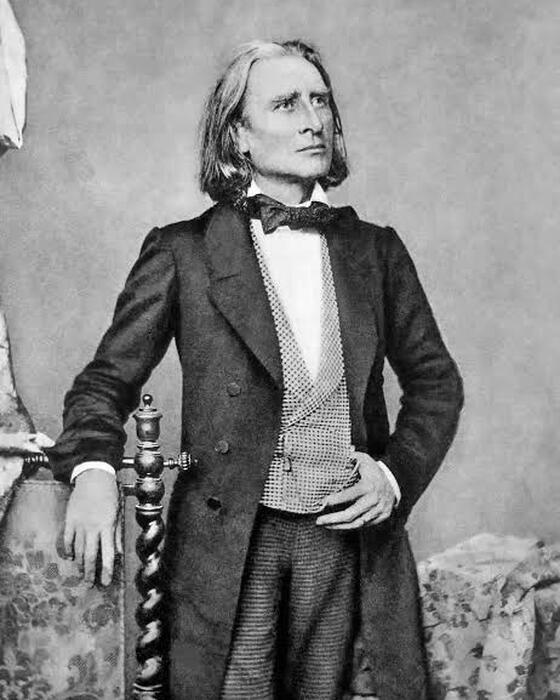
FRANZ LISZT
Born October 22, 1811 in Doborján, Hungary (now Raiding, Austria);
Died July 31, 1886 in Bayreuth, Germany.
Totentanz (Danse macabre) FOR PIANO & ORCHESTRA
- First performed on March 15, 1865 in The Hague, with Hans von Bülow as soloist.
- First performed by the Des Moines Symphony on September 22 & 23, 2001 with Janina Fialkowska, piano and Joseph Giunta conducting.
(Duration: ca. 15 minutes)
Liszt’s grandiose Totentanz (“Dance of Death”) for Piano & Orchestra was said to have been inspired by either Hans Holbein’s series of woodcuts of the same name or Francesco Traini’s mid-14th century painting The Triumph of Death, depending on which Liszt biographer is consulted — Traini seems to have garnered the most votes. Liszt saw Traini’s dramatic fresco (earlier attributed to both Andrea Orcagna and the Lorenzettis) when he visited the Camposanto (cemetery building) next to the Pisa Cathedral in 1839 during his first stay in Italy. The painting is a vivid depiction of heaven and hell, showing mortal man in varying conditions of pleasure and pain. The righteous are escorted by angels into the sweet after-life while the horrified damned are bound by devils to a flaming mountain. Death is shown as a batlike, female figure with claws, leveling king and beggar alike beneath the swing of her scythe. Here, indeed, was the stuff of ripest Romantic fantasy.
Liszt immediately sketched some ideas for a series of free variations on the Dies Irae (“Day of Wrath”) from the Roman Catholic Requiem that would depict different characters caught in the whirling Dance of Death. After the initial burst of activity on the score in 1839, however, Liszt laid it aside for a full decade before resuming work on it in 1849, and then again in 1853. It was revised six years later, but not heard until 1865, a quarter-century after the composer was first smitten by the blazing images in Pisa.
American musicologist Abraham Veinus described the Totentanz as “perhaps the most astounding combination of diabolism and virtuosity in the history of piano writing.” Its unearthly mood is established immediately by two measures of ominous chords rumbling from the depths of the piano after which the low winds and strings intone the lugubrious Dies Irae theme. A sweeping cadenza at the end of the introduction is only the opening salvo in the display of pianistic fireworks that follow. Richard Pohl, an intimate of Liszt and one of his early biographers, traced the further adventures of the Dies Irae theme: “Irresistibly and irrevocably does this threatening motif advance, now clearly brought forward as a subject, now as a counterpoint serving as a bass, now covered over with manifold strange figures and original metamorphoses. And every variation discloses some new character — the earnest man, the flighty youth, the scornful doubter, the prayerful monk, the daring soldier, the tender maiden, the playful child.” Pohl’s description will do as nicely as any technical analysis, and probably even more accurately reflects the composer’s expressive intent.
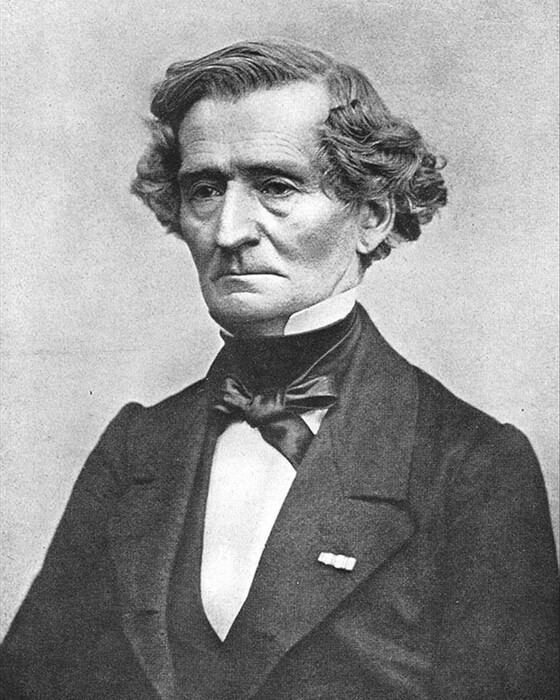
HECTOR BERLIOZ
Born December 11, 1803 in Côte-Saint-André, France;
Died March 8, 1869 in Paris.
Symphonie Fantastique, Op. 14a
- First performed on December 5, 1830 at the Paris Conservatoire, conducted by François Habeneck.
- First performed by the Des Moines Symphony on March 11, 1972 with Thomas Griswold conducting. Five subsequent performances took place, most recently on April 1 & 2, 2017 with Joseph Giunta conducting.
(Duration: ca. 50 minutes)
By 1830, when he turned 27, Hector Berlioz had won the Prix de Rome and gained a certain notoriety among the fickle Parisian public for his perplexingly original compositions. Hector Berlioz was also madly in love. The object of his amorous passion was an English actress of middling ability, one Harriet Smithson, whom the composer first saw when a touring English theatrical company performed Shakespeare in Paris in 1827. During the ensuing three years, this romance was entirely one-sided, since the young composer never met Harriet, but only knew her across the footlights as Juliet and Ophelia. He sent her such frantic love letters that she never responded to any of them, fearful of encouraging a madman.
Berlioz was still nursing his unrequited love for Harriet in 1830 when, full-blown Romantic that he was, his emotional state served as the germ for a composition based on this “Episode from the Life of an Artist,” as he subtitled the Symphonie Fantastique. In this work, the artist visualizes his beloved through an opium-induced trance, first in his dreams, then at a ball, in the country, at his execution and, finally, as a participant in a witches’ sabbath. She is represented by a musical theme that appears in each of the five movements, an idée fixe (a term Berlioz borrowed from the just-emerging field of psychology to denote an unhealthy obsession) that is transformed to suit its imaginary musical surroundings. The idée fixe is treated kindly through the first three movements, but after the artist has lost his head for love (literally — the string pizzicati followed by drum rolls and brass fanfares at the end of the March to the Scaffold represent the fall of the guillotine blade and the ceremony of the formal execution), the idée fixe is transmogrified into a jeering, strident parody of itself in the finale. Berlioz did in fact marry his Harriet-Ophelia-Juliet in 1833, but their happiness faded quickly, and they were virtually estranged within a decade.
The composer gave the following program as a guide to the Symphonie Fantastique: “A young musician of morbid sensibility and ardent imagination poisons himself with opium in a fit of amorous despair. The narcotic dose, too weak to result in death, plunges him into a heavy sleep accompanied by the strangest visions, during which his sensations, sentiments and recollections are translated in his sick brain into musical thoughts and images. The beloved woman herself has become for him a melody, like a fixed idea which he finds and hears everywhere.
“PART I: Reveries and Passions. The young musician first recalls that uneasiness of soul he experienced before seeing her whom he loves; then the volcanic love with which she suddenly inspired him, his moments of delirious anguish, of jealous fury, his returns to loving tenderness, and his religious consolations.
“PART II: A Ball. He sees his beloved at a ball, in the midst of the tumult of a brilliant fête.
“PART III: Scene in the Country. One summer evening in the country he hears two shepherds playing a ranz-des-vaches in alternate dialogue; this pastoral duet, some hopes he has recently conceived, combine to restore calm to his heart; but she appears once more, he is agitated with painful presentiments; if she were to betray him! ... One of the shepherds resumes his artless melody, the other no longer answers him. The sun sets ... the sound of distant thunder ... solitude ... silence ...
“PART IV: March to the Scaffold. He dreams that he has killed his beloved, that he is condemned to death, and led to execution. The procession advances to a march which is now somber and wild, now brilliant and solemn. At the end, the idée fixe reappears for an instant, like a last love-thought interrupted by the fatal stroke.
“PART V: Dream of a Witches’ Sabbath. He sees himself at the Witches’ Sabbath, amid ghosts, magicians and monsters of all sorts, who have come together for his obsequies. He hears strange noises, groans, ringing laughter, shrieks. The beloved melody reappears, but it has become an ignoble, trivial and grotesque dance-tune; it is she who comes to the Witches’ Sabbath.... She takes part in the diabolic orgy ... Funeral knells, burlesque parody on the Dies Irae [the ancient ‘Day of Wrath’ chant from the Roman Catholic Requiem Mass for the Dead]. Witches’ Dance. The Witches’ Dance and the Dies Irae together.”